

Few metrics are more frustrating to travel marketers than seeing strong booking intent end in abandonment. Industry estimates consistently place checkout abandonment rates at high levels. Standard explanations include price sensitivity, comparison shopping, and casual browsing. Those factors absolutely play a role, but for experience-driven travelers—those prioritizing meaningful, high-impact experiences—another factor is often overlooked: uncertainty.
In some cases, travelers abandon checkout not because they have lost interest, but because they are not yet confident the experience is the right fit. They may still have questions about what to expect, whether the experience matches their needs, or if the value justifies the cost. Many booking paths are built primarily to collect information and process payment. When uncertainty remains late in the journey, that approach may create friction instead of confidence.
This is especially relevant for higher-consideration travel decisions. Booking a weekend hotel stay may feel relatively straightforward. Committing to a multi-day guided adventure, premium family vacation, or specialized experience often carries more perceived risk. The investment is typically greater, expectations are higher, and the cost of choosing poorly can feel significant.
At the point of conversion, travelers are often making a final confidence check. They may be wondering whether the experience truly fits their interests, comfort level, schedule, or who they’re traveling with. If those questions remain unanswered, uncertainty can quickly become abandonment.
Many booking paths are designed to process a transaction, not resolve last-minute hesitation. But for experience-driven travelers, confidence often determines whether the sale is completed. The opportunity for travel brands is to identify where confidence breaks down and improve the booking experience so more travelers complete the purchase.
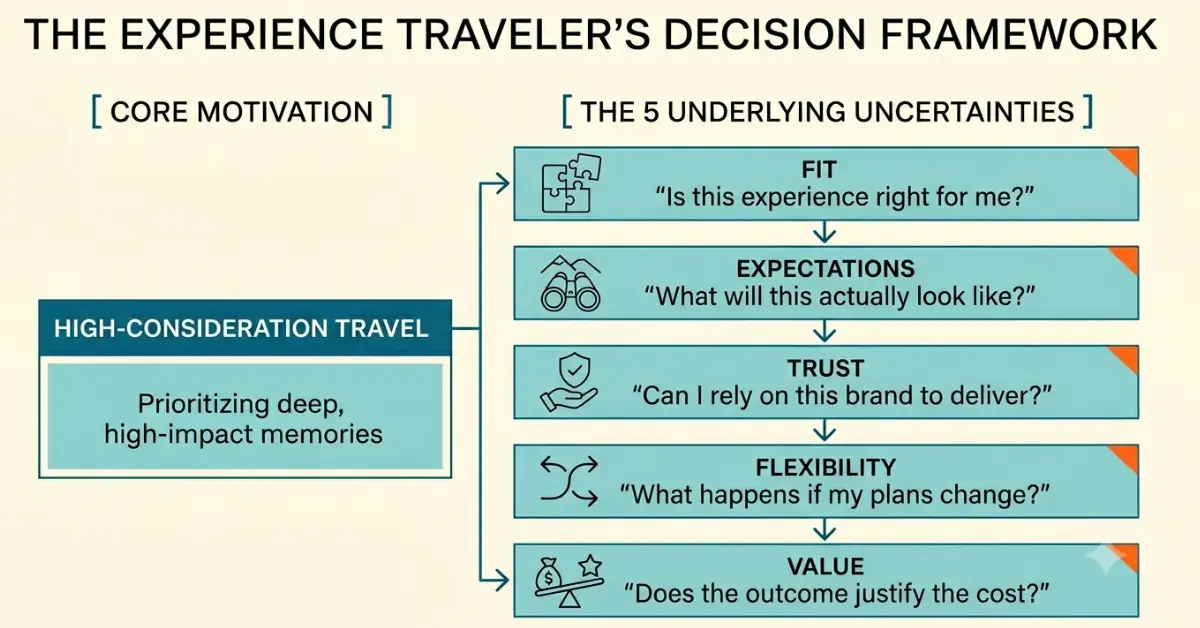
How Uncertainty Shows Up in the Booking Experience
Uncertainty doesn’t look the same for every traveler. As booking intent increases, it often surfaces through specific questions that interrupt the path to purchase. For experience-driven travel, these moments typically center around fit, expectations, trust, flexibility, and value.
Uncertainty About Fit
Travelers may pause if they are not confident the experience matches their interests, ability level, or travel style—especially as more travelers choose experiences that reflect who they are and how they see themselves. This is especially common for higher-consideration experiences.
For example, a family considering an outdoor excursion may be unsure whether the activity is appropriate for younger children, while a traveler booking a guided tour may question whether the pace or difficulty aligns with their comfort level.
When this uncertainty isn’t addressed, travelers may seek additional information—or abandon the booking altogether rather than risk a poor fit.
To reduce this uncertainty, booking paths should clearly signal who the experience is best suited for—and just as importantly, who it may not be a fit for. Defining ideal participants based on factors like experience level, pace, or travel style—particularly on experience pages and early in the selection process—helps travelers quickly self-select, making it easier to move forward with confidence.

Uncertainty About What to Expect
Even when interest is high, uncertainty about what the experience will actually be like can delay a decision. Questions around environment, pacing, crowd levels, or overall structure can create enough uncertainty to stall progress.
For instance, a traveler booking an attraction may wonder how busy it will feel at certain times of day, or what a typical visit actually looks like beyond polished marketing imagery.
If these details aren’t easy to understand, travelers may leave the booking process to search for answers elsewhere—and not return.
Reducing this uncertainty comes down to helping travelers visualize the experience in concrete terms. Providing context around how time is spent, what a typical visit looks like, and including sample itineraries—before travelers reach pricing or checkout—can make the experience feel more tangible, limiting the need for last-minute research.
Uncertainty About Trust and Credibility
Confidence breaks down quickly when travelers aren’t sure an experience will deliver as promised. This is especially true when booking with unfamiliar brands, lesser-known operators, or experiences that are difficult to evaluate upfront.
A traveler may question whether reviews reflect real experiences, whether imagery accurately represents the offering, or whether the provider is reputable.
Without strong signals of credibility, even highly interested travelers may choose not to commit.
To build confidence, booking paths should rely on authentic proof points—such as credible reviews, consistent messaging across channels, and content that reflects real experiences rather than idealized ones. These signals are especially important as travelers move between brand sites, partner listings, and third-party platforms, where inconsistencies can quickly erode trust.
Uncertainty About Flexibility and Risk
Risk becomes more apparent as travelers consider what happens if plans change. As a result, policies around cancellations, refunds, and rescheduling play a significant role in how comfortable someone feels completing a booking.
If these policies are unclear, difficult to find, or overly restrictive, the perceived risk of committing increases.
Even when travelers understand the rationale behind stricter policies, the lack of flexibility can stop a booking at the final step.
Clear, accessible policy information should not only be easy to find, but easy to understand in practical terms—particularly near pricing and checkout, when commitment feels most immediate. When travelers can quickly assess what happens if plans change, the perceived downside of committing is reduced.
Uncertainty About Value
As travelers reach the final stages of booking, the focus often shifts to whether the experience justifies the cost. This is especially true for higher-priced or bundled experiences where the full value may not be immediately clear.
A traveler may pause if the price feels high relative to what they understand about the experience, or if they begin comparing alternatives before completing the purchase.
If the value is not clearly reinforced, that moment can lead to abandonment.
To address this, booking paths should clearly connect what is included to the overall experience—especially at the point where total cost is presented—helping travelers understand not just the price, but what they’re getting in return. Framing value in terms of the experience itself—not just line items—can make the decision feel more justified.
Each of these moments represents a different way uncertainty can interrupt the booking process. When travel brands address these friction points, they create a clearer path from intent to action.
How to Improve Travel Booking Conversion Without Overcomplicating It
Travel brands don’t need to rebuild their booking experience from scratch to reduce abandonment. In most cases, small adjustments that address key moments of uncertainty can have a meaningful impact. The goal is not to add more steps, but to remove the friction that prevents travelers from feeling confident enough to complete the purchase.
Focus on the Moments Closest to Conversion
Not every part of the booking journey carries the same weight. As travelers move from browsing into selecting dates, reviewing pricing, and entering checkout, their attention shifts toward final questions around fit, value, and risk.
Prioritizing these late-stage moments—such as the transition from experience details to ticket selection or the step just before payment—can have a greater impact than trying to optimize the entire journey at once.
Reinforce, Don’t Add Friction
Improving the booking experience doesn’t require adding new steps or complexity. In many cases, the most effective changes come from reinforcing key information within the flow.
For example, experience details, inclusions, or key expectations can be surfaced alongside pricing or selection screens—helping travelers move forward without needing to leave the booking process to find answers elsewhere.
Start with What You Can Control
Not every brand owns the full booking experience. DMOs, partners, and third-party platforms often influence how travel decisions are completed.
Even within those constraints, brands can influence how expectations, value, and trust are communicated leading up to the booking step—such as through experience pages, campaign landing pages, or partner content that shapes the decision before checkout.
Test and Refine Over Time
Improving conversion doesn’t require a complete redesign. Incremental changes—such as clarifying value on pricing pages or making key details more visible during checkout—can reveal what has the greatest impact.
Over time, these smaller improvements can compound, creating a more effective booking experience without introducing unnecessary complexity.

Don’t Let Uncertainty Break the Booking Moment
High abandonment rates are often treated as a pricing problem or a symptom of comparison shopping. But for experience-driven travel, the bigger challenge is often confidence.
As travelers move closer to booking, they’re not just completing a transaction—they’re making a decision about how they’ll spend their time, money, and energy. When key questions around fit, expectations, trust, risk, or value remain unanswered, even strong intent can fall apart at the final step.
The opportunity for travel brands isn’t to overhaul the entire booking experience. It’s to recognize where uncertainty surfaces and make it easier for travelers to move forward with clarity.
When booking paths are designed to support decision-making—not just process payments—they create a stronger connection between intent and action. In a category where every trip carries weight, that difference matters.
Frequently Asked Questions
Why do travelers abandon checkout in travel booking?
Travelers abandon checkout for a variety of reasons, including price sensitivity, comparison shopping, and browsing behavior. However, for experience-driven travelers, abandonment often happens when key questions remain unresolved—particularly around fit, expectations, trust, flexibility, and value.
What is an experience-driven traveler?
An experience-driven traveler prioritizes meaningful, high-impact experiences over purely transactional purchases. These travelers place greater importance on how an experience aligns with their expectations, interests, and personal goals, which can increase the level of consideration before booking.
How does uncertainty impact booking conversion rates?
Uncertainty can interrupt the booking process at the final stage, even when intent is high. When travelers are unsure whether an experience is the right fit or worth the investment, they are more likely to delay or abandon the purchase.
What are the most common types of uncertainty in travel bookings?
Uncertainty typically shows up in five key areas:
Fit (Is this right for me?)
Expectations (What will this be like?)
Trust (Can I rely on this experience?)
Flexibility (What happens if plans change?)
Value (Is this worth the cost?)
How can travel brands reduce checkout abandonment?
Rather than adding more steps to the booking process, travel brands can improve conversion by reinforcing key information at critical moments. Clarifying expectations, building trust, and making value easier to understand can help travelers feel more confident completing their booking.